
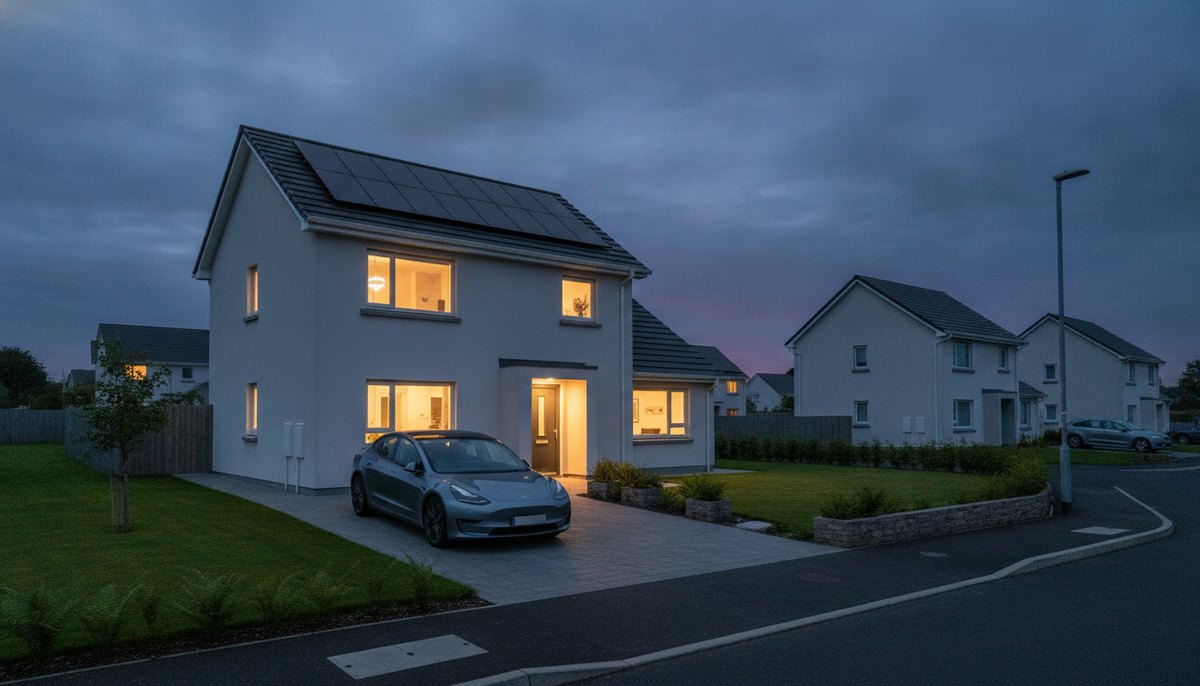
Night rate electricity gives you a cheaper unit price during an overnight window, typically 23:00 to 08:00 in winter and 00:00 to 09:00 in summer on a traditional day/night (NightSaver) meter. Night unit rates in 2026 run roughly 10–22c/kWh depending on the supplier and the exact window, against a flat rate of around 30–35c/kWh. It pays off when you can move a big chunk of your usage into the cheap hours, which is exactly what a home battery or an EV lets you do. Solar panels plus a battery on a night rate is the combination that squeezes the most out of it.
What Is Night Rate Electricity?
Night rate electricity is a two-price tariff: you pay one rate during the day and a lower rate during a fixed overnight window. It has been sold in Ireland for decades under the NightSaver name, originally for people running storage heaters and immersion heaters overnight. The idea is simple. Demand on the grid is low overnight and wind generation is often high, so electricity is cheaper to supply, and suppliers pass some of that saving on.
Unlike a dynamic tariff, where the price changes every half hour and tracks the wholesale market, a night rate is fixed and predictable. You know the exact hours and the exact price in advance. That predictability is the appeal for anyone who wants to schedule heavy loads, charge a battery, or plug in a car without watching a live price feed.
What Are the Night Rate Hours in Ireland?
On a traditional day/night (NightSaver) meter, the night window shifts with the clocks:
| Season | Night rate window | Length |
|---|---|---|
| Winter (clocks back, late Oct–late Mar) | 23:00 – 08:00 | 9 hours |
| Summer (clocks forward, late Mar–late Oct) | 00:00 – 09:00 | 9 hours |
The window moves by one hour when the clocks change, so you always get the same nine-hour block relative to solar time. On a smart meter the picture is a little different. Smart tariffs set their own night band. Electric Ireland's smart night rate, for example, runs 23:00 to 08:00 year round, and several suppliers layer an even cheaper "super off-peak" window inside the night, aimed squarely at EV charging (more on that below). If you also have solar, it is worth checking which actually wins: we compare charging an EV off your own panels against a cheap night band, and the night band comes out ahead more often than people expect.
A legacy NightSaver meter is a separate physical meter that only records day and night usage. A smart meter records your usage in half-hourly intervals and can run any modern time-of-use tariff, including night rate and dynamic plans. As the national smart meter rollout continues, new night-rate style plans are built around smart meters rather than the old NightSaver hardware. If you are getting a battery or an EV, a smart meter is the flexible option, and it is also what lets you get paid for exporting surplus solar.
Night Rate Prices in 2026
Night unit rates vary by supplier, by plan, and by how deep into the night the window sits. As a snapshot of the market in mid-2026, verified against supplier pages:
| Supplier / plan | Night rate | Window |
|---|---|---|
| Electric Ireland smart night rate | ~16.93c/kWh | 23:00 – 08:00 |
| Electric Ireland EV Night Boost | ~9.94c/kWh | 02:00 – 04:00 |
| Energia EV Smart Drive (super off-peak) | ~9.42c/kWh | 02:00 – 06:00 |
| Typical NightSaver night rate (market average) | ~18c/kWh | 23:00 – 08:00 (winter) |
Rates include VAT and are indicative for mid-2026. Supplier prices change, so confirm the current rate directly with the supplier before switching. Electric Ireland figures reflect its listed smart plan including standard discounts.
Two things stand out. First, the deepest discounts sit in the small hours: the EV-focused "boost" windows around 2am to 6am are where you get electricity for under 10c/kWh, roughly a third of the daytime price. Second, a broad "all night" band like 23:00–08:00 is less aggressively priced, because the supplier is discounting nine hours rather than two or four. The trade-off is convenience against the size of the saving.
Is Night Rate Electricity Worth It?
A night rate only saves you money if you actually use enough electricity at night to outweigh two costs: the higher daytime unit rate, and a standing charge that is often higher on a day/night plan than on a standard flat plan. If you barely use anything overnight, a two-price tariff can leave you worse off than a simple 24-hour rate.
As a rough guide, comparison analyses put the break-even point at moving somewhere around a quarter of your total usage into the night window. Below that, the daytime premium eats the saving. Above it, the night rate wins, and the more you can shift, the more you save. That is a hard target to hit with ordinary household habits alone, which is why night rates historically suited storage-heater homes, and why today they suit three specific setups:
- Homes with a battery. A battery lets you charge from the grid at the night rate and discharge during the expensive daytime and evening peak. This is time-of-use arbitrage, and it is the single most effective way to use a night rate. It works with no panels at all, though the sums are tighter: see a home battery without solar panels for the payback.
- Homes with an EV. Charging a car at ~9–10c/kWh overnight instead of ~35c during the day is a large, recurring saving, often a few hundred euro a year depending on mileage.
- Homes with electric heating or a hot-water immersion. Heating water or storage heaters on a timer during the cheap hours is the original NightSaver use case and still works.
Night Rate, Solar and a Battery: How They Fit Together
This is where night rate gets genuinely interesting for solar homeowners, and it comes down to the seasons.
In summer, your solar panels do the heavy lifting. A home battery fills up from surplus solar during the day for free, then powers the house into the evening. You rarely need to touch the grid, so the night rate barely matters, because the panels have already given you cheaper-than-night electricity at zero marginal cost.
In winter, the maths flips. Irish solar output in December and January is a fraction of the summer figure, so the battery often finishes the short day only part full. On a night rate, you can top the battery up from the grid at ~10–17c/kWh in the small hours, then run the house off it through the expensive daytime and the 5–9pm peak. You are buying cheap winter electricity and using it when it would otherwise cost double.
Put simply: solar covers you in summer, and a night rate covers the battery in winter. Together they keep your import bill low all year. Most modern hybrid inverters can be set to charge the battery only during a defined cheap window, so once it is configured it runs itself. If you are getting quotes, ask the installer whether the battery system supports scheduled time-of-use charging. Nearly all do, but confirm it for the specific model.
No. What you are paid for exporting surplus solar is set by the Clean Export Guarantee, and that rate is separate from your import tariff. Your night rate is about the electricity you buy; the CEG is about the electricity you sell. They sit side by side on the same bill and do not affect each other.
Night Rate vs Dynamic Tariff: Which Should a Solar Home Choose?
Both are time-of-use tariffs, and both reward moving usage off the evening peak. The difference is how the price behaves:
| Night rate | Dynamic tariff | |
|---|---|---|
| Price | Fixed cheap band, same every night | Changes every half hour, tracks wholesale |
| Predictability | High. You know the price in advance | Lower. Price is set day-ahead |
| Best for | Battery/EV charging on a simple schedule | Battery homes that can chase the cheapest half-hours |
| Effort | Set a timer once | Needs smart automation to get the most from it |
For most solar and battery homes, a night rate is the simpler starting point: set the battery to charge overnight and forget it. A dynamic tariff can beat it if your inverter automates charging around the cheapest half-hour blocks, but it takes more setup. Both need a smart meter.
Thinking about solar and a battery?
Get matched with SEAI-registered installers who can size a battery for night-rate charging and time-of-use savings.
Get a QuoteFrequently Asked Questions
What are the night rate electricity hours in Ireland?
On a standard day/night (NightSaver) meter, the night rate runs 23:00 to 08:00 in winter and 00:00 to 09:00 in summer, a nine-hour window that shifts by an hour when the clocks change. Smart-meter night tariffs set their own band; Electric Ireland's smart night rate, for example, runs 23:00 to 08:00 year round, and some suppliers add a cheaper super off-peak window around 2am to 6am for EV charging.
How much is night rate electricity in Ireland in 2026?
Night unit rates in 2026 run roughly 10–22c/kWh depending on the supplier and window, against a flat rate of around 30–35c/kWh. The cheapest rates are in the EV "boost" windows: Electric Ireland's EV Night Boost is around 9.94c/kWh from 02:00 to 04:00 and Energia's EV Smart Drive super off-peak is around 9.42c/kWh from 02:00 to 06:00. A broad all-night NightSaver band averages closer to 18c/kWh. Confirm the current rate with the supplier, as prices change.
Is night rate electricity worth it?
It is worth it if you can shift a meaningful share of your usage, roughly a quarter or more, into the cheap overnight window, enough to outweigh the higher daytime rate and the usually higher standing charge on a day/night plan. That is hard with ordinary habits, but easy if you have a home battery, an EV, or electric heating you can run on a timer. If you use very little at night, a standard flat tariff is usually better.
Should I charge my home battery on a night rate?
Yes, especially in winter. A battery can charge from the grid at the night rate (around 10–17c/kWh) and discharge during the expensive daytime and 5–9pm peak, so you avoid importing at 30c or more. In summer your solar panels usually fill the battery for free, so night-rate charging matters less. Most hybrid inverters can be set to charge only during a defined cheap window, so the arbitrage runs automatically once configured.
Do I need a smart meter for a night rate?
Not for a legacy NightSaver plan, which uses a separate day/night meter. But newer night-rate and EV tariffs are built around smart meters, and a smart meter is also what lets you get paid for exporting surplus solar under the Clean Export Guarantee. If you are adding a battery or an EV, a smart meter is the flexible choice. Installation is free through the national rollout.
Does a night rate affect my solar export payments?
No. Your solar export earnings are set by the Clean Export Guarantee rate, which your supplier fixes separately from your import tariff. The night rate only affects the price of the electricity you buy. The two appear on the same bill but are calculated independently.