
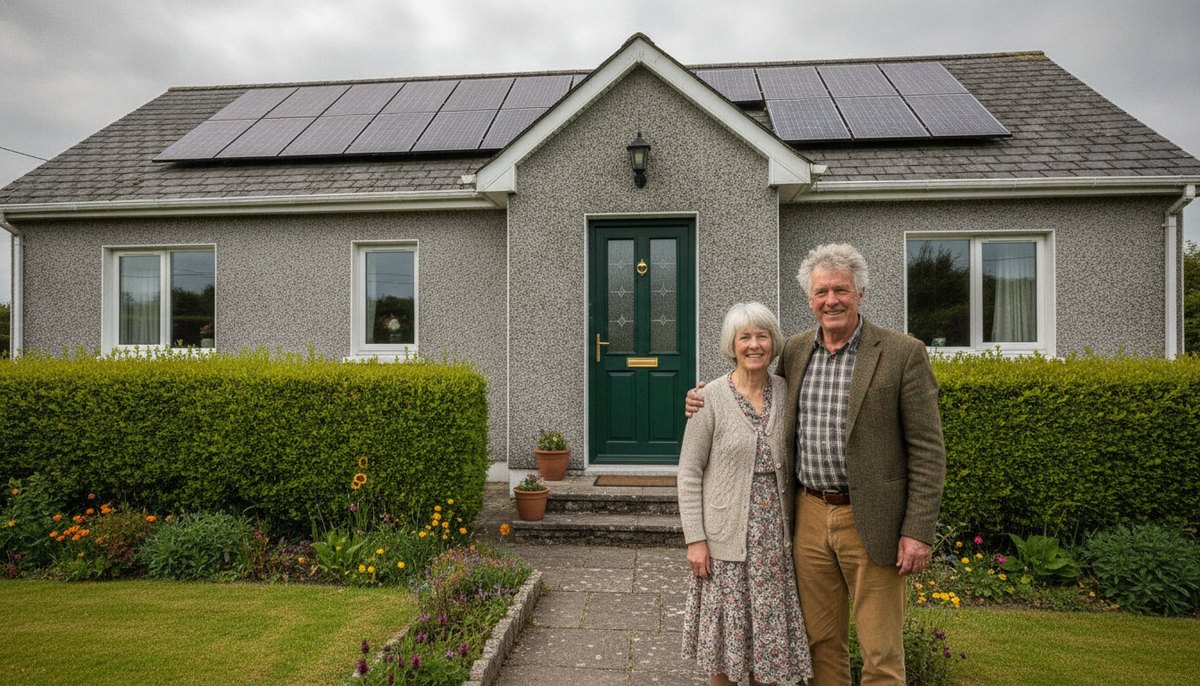
There is no SEAI grant specifically for pensioners or over-70s in Ireland. Every SEAI grant is open to all homeowners regardless of age. What pensioners do have is a side door that younger households mostly cannot use: once you turn 66, you can qualify for the Fuel Allowance on a means test alone, with no other welfare payment needed. And Fuel Allowance is a qualifying payment for the Warmer Homes Scheme, which insulates your home completely free of charge. It also gets you higher rates on the standard attic and cavity wall insulation grants. So the real question is not "is there a pensioner grant" but "which of the two routes are you on".
- No age-specific grant exists. Nothing extra at 66, 70 or 80
- Route 1 (free): on Fuel Allowance, in a pre-2006 home with a BER of C to F? The Warmer Homes Scheme does insulation, and sometimes heating and windows, at no cost
- Route 2 (part-funded): everyone else uses the standard grants: up to €2,500 for attic insulation, up to €14,500 for a heat pump, €1,800 for solar panels
- The 66+ advantage: Fuel Allowance needs no qualifying welfare payment once you are 66, just a means test (€534 a week for a single person, €1,068 for a couple)
- Solar PV: since 6 October 2026 the Government says Warmer Homes includes solar PV and a battery as standard, and on Fuel Allowance the solar grant rises to €8,400 plus €600 for a battery
The Two Routes, and Which One You Are On
SEAI runs its home energy schemes in two tiers. The Warmer Homes Scheme is fully funded: SEAI appoints the contractor, pays the whole bill, and you are not charged. It is reserved for homeowners getting certain social welfare payments. Everyone else uses the individual upgrade grants (the Better Energy Homes scheme), which pay a fixed amount per measure and leave the balance with you.
For most working-age households, the free scheme is out of reach unless they are on payments like the Working Family Payment or Carer's Allowance. Pensioners are different, because the most common qualifying payment of all, the Fuel Allowance, drops its own requirements at 66.
Route 1: Fuel Allowance First, Then Free Upgrades
Here is the sequence that matters. To get the Warmer Homes Scheme you must be getting a qualifying payment; the State Pension on its own is not one, and neither is the Household Benefits Package. But Fuel Allowance is. And once you are 66 or over, you no longer need any other welfare payment to claim Fuel Allowance. You just need to pass its means test:
- Gross weekly income up to €534 for a single person, or €1,068 for a couple
- The first €50,000 of savings and investments is ignored for over-66s, and your own home is never counted
- You must live alone or with certain people, such as a spouse or someone also aged 66 or over
Those limits are wider than many pensioners assume. A couple on the full State Pension with a modest occupational pension on top can still come in under €1,068 a week. The allowance itself pays €38 a week over the winter months (28 weeks in the 2025/26 season, extended by four weeks to 1 May 2026 because of fuel costs). You can apply online at mywelfare.ie with a MyGovID account, or on the paper NFS2 form if you are 66 or over.
Once the Fuel Allowance is in payment, the Warmer Homes door opens, provided your home also qualifies:
- You own the home and live in it
- It was built and occupied before 2006
- It has a BER of C, D, E or F (SEAI does a free BER check if you do not have one)
What the free scheme actually does
The Warmer Homes Scheme covers attic insulation, wall insulation (cavity, internal or external as the surveyor recommends), draught-proofing, lagging jackets, energy-efficient lighting and energy advice. New central heating systems and replacement windows are covered occasionally rather than routinely: since 1 January 2025 the scheme will not fit a new oil or gas boiler, only renewable systems such as a heat pump, and windows are replaced only where the walls are being insulated at the same time and the existing glazing is single-glazed.
The catch is the queue. The process from application to finished works usually takes 24 to 26 months, first come, first served. That is worth knowing before you turn down a smaller grant now in the hope of free works later. The other conditions are mild: you can apply more than once if your home would still benefit, and if you sell within 5 years you must tell SEAI, who may ask for some of the cost back. We cover the scheme in full, including the survey and what the contractors will and will not do, in our Warmer Homes Scheme guide.
Until 6 October 2026 it did not install solar panels; since then the Government says solar PV and a 5 kWh battery are standard measures (SEAI's own Warmer Homes page had not added solar to its list when we checked on 7 October 2026). There is still no scheme that gives pensioners free solar PV because of their age, whatever the ads on social media suggest. We have unpicked that claim, and what an eligible pensioner can actually get towards solar, in free solar panels for pensioners.
Route 2: The Standard Grants (With a Quiet Bonus for Fuel Allowance Recipients)
If your income is above the Fuel Allowance limits, or your home is newer than 2006 or already rated B, you use the same individual grants as everyone else. No means test, no age rule. The home must have been built and occupied before 2011 for insulation and heating controls, before 2021 for a heat pump, and before 2025 for solar PV, solar thermal or a battery. Those last three moved out from 2021 on 6 October 2026; the heat pump date did not move with them. You need grant approval before any work starts, an SEAI-registered contractor, and a BER assessment afterwards.
These are the 2026 maximum grant values for the measures pensioners ask about most, for a semi-detached house (apartments get less, detached houses more):
| Upgrade | Standard grant | Higher rate* |
|---|---|---|
| Attic insulation | €1,500 | €1,900 |
| Cavity wall insulation | €1,300 | €1,700 |
| External wall insulation | €6,000 | – |
| Heat pump (house, all types except air-to-air) | €6,500 | – |
| Heating controls | €700 | – |
| Solar water heating | €1,200 | – |
| Solar PV panels | €1,800 max | – |
| New windows | €3,000 | – |
| New external doors | €800 per door (max 2) | – |
*The higher attic and cavity rates apply if you are getting a qualifying social welfare payment; SEAI checks this against the same list used for the Warmer Homes Scheme, which includes the Fuel Allowance. Figures shown are for a semi-detached or end-of-terrace house. A detached house gets more (for example €2,500 attic insulation at the higher rate); an apartment or mid-terrace gets less.
This is the overlooked middle option for pensioners on Fuel Allowance who cannot face a two-year Warmer Homes queue: take the higher-rate insulation grants now, pick your own SEAI-registered contractor, and have the work done in weeks rather than years. You pay the balance, but the grant covers a meaningful share of a straightforward attic or cavity job. Our insulation grants guide breaks down typical costs against each grant, and the heat pump grant guide covers the €6,500 route and the technical assessment that comes first.
Solar Panels for Pensioners: The €1,800 Grant, Same as Everyone
The Solar Electricity Grant has no age rule, no income rule and no means test. It pays €700 per kWp for the first 2 kWp and €200 per kWp up to 4 kWp, capping at €1,800 in 2026, and since May 2023 home solar carries 0% VAT on supply and installation. Your home must have been built and occupied before 2025, which almost every pensioner's home clears comfortably, and you must have grant approval before any work starts. The full conditions are in our eligibility guide. If you receive Fuel Allowance, do not stop at €1,800: from 6 October 2026 the panel grant for your household is €8,400 plus €600 for a battery.
Solar happens to suit retired households better than most. Panels generate through the middle of the day, roughly 9am to 4pm, which is exactly when someone at home in retirement is boiling kettles, running washes and heating rooms. Using that power directly, instead of exporting it for a smaller credit, is what shortens the payback.
Every installer we work with is on SEAI's registered list, so the €1,800 grant applies. Get quotes for your home. The form takes about a minute — free, no obligation.
Get a Quote →Is There Anything Extra at 70?
No. Searches for "SEAI grants for over-70s" are common, but no SEAI scheme changes at 70. The meaningful birthday is 66, when the Fuel Allowance means test replaces the qualifying-payment requirement. Nor does the Warmer Homes Scheme move older applicants up the list: it prioritises the oldest and least efficient homes, and otherwise works through applications first come, first served. If anyone tells you age alone gets you free works, or free panels, treat it as a sales pitch, not a scheme.
Frequently Asked Questions
No. SEAI has no age-specific grant, and nothing changes at 70. What pensioners have is easier access to the free Warmer Homes Scheme, because from age 66 the Fuel Allowance can be claimed on a means test alone, and Fuel Allowance is a qualifying payment for the scheme.
Only through the Warmer Homes Scheme. If you are getting Fuel Allowance (or another qualifying payment), own and live in a home built before 2006 with a BER of C to F, SEAI will insulate the attic and walls free of charge. Pensioners not on a qualifying payment use the standard grant instead, worth up to €2,000 for a detached house (€2,500 at the higher rate).
The standard individual grants, including the €1,800 solar grant, are not means-tested at all. Only the free Warmer Homes Scheme is income-restricted, and even there the test is indirect: you qualify by being on a payment such as Fuel Allowance, which for over-66s has its own means test of €534 a week for a single person or €1,068 for a couple.
Not because of age. But since 6 October 2026 the Government says the Warmer Homes Scheme includes solar PV and a battery as standard, so a pensioner on Fuel Allowance in a home built before 2006 can get them fully funded (with a long wait), or claim SEAI's enhanced grant of €8,400 plus €600 for a battery. Other pensioners get the standard SEAI solar grant of up to €1,800 plus 0% VAT, on the same terms as every other homeowner.
The process from application to completed works usually takes 24 to 26 months, handled first come, first served. Applications are free, so it costs nothing to join the queue while you weigh up whether to do smaller jobs sooner under the standard grants.
Not on its own. The State Pension is not a qualifying payment for the scheme, and neither is the Household Benefits Package. The route in is the Fuel Allowance: claim that first (at 66 or over you only need to pass its means test), and once it is in payment you can apply for the Warmer Homes Scheme if your home was built before 2006 and has a BER of C to F.
Sources: Citizens Information — Warmer Homes Scheme (page edited 28 May 2026) — qualifying payments, pre-2006 and BER C–F rules, covered upgrades, renewable-only heating since January 2025, 24–26 month timeline, reapplication and 5-year sale rules; Citizens Information — Fuel Allowance (page edited 17 April 2026) — over-66 means test with no qualifying payment required, €534/€1,068 weekly income limits, €50,000 capital disregard, €38 weekly rate from January 2026, NFS2 form; Citizens Information — Individual home energy upgrade grants (page edited 28 May 2026) — grant values by house type, higher attic and cavity rates for qualifying-payment recipients, pre-2011 and (at that date) pre-2021 property rules, approval-before-works requirement. The solar PV, solar thermal and battery property rule moved to pre-2025 on 6 October 2026, verified that day against seai.ie; the heat pump rule did not move.
Published: 10 July 2026. Author: Neil Russell.