
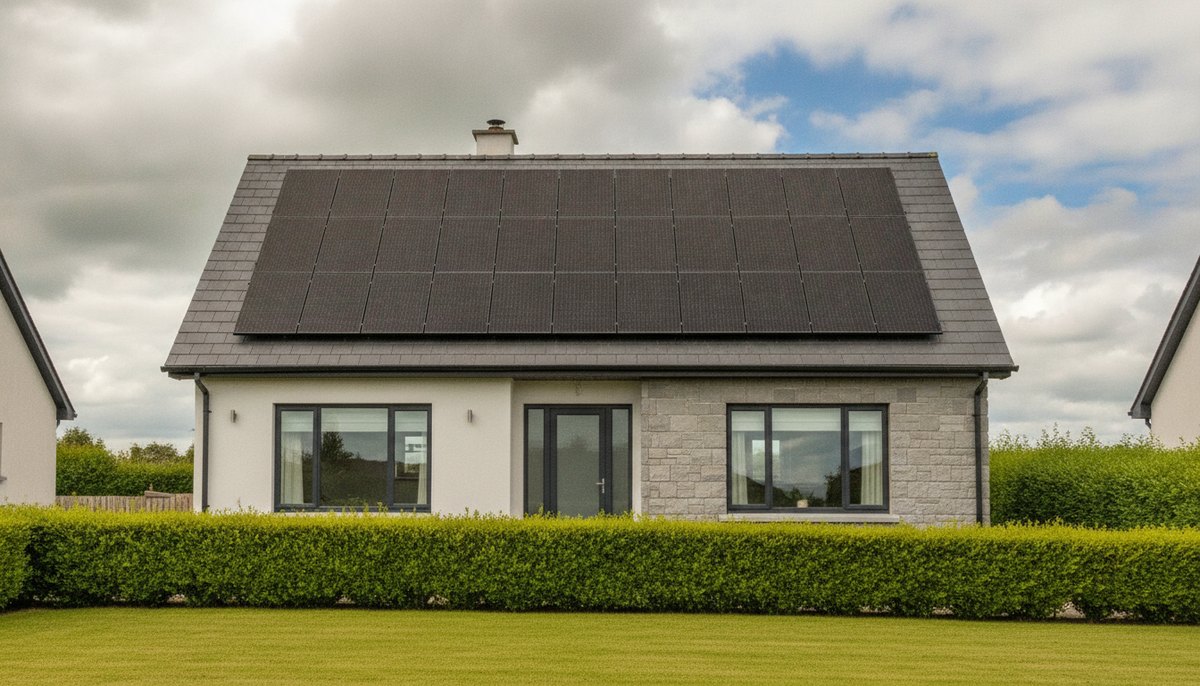
You qualify for the SEAI Solar Electricity Grant if you own a home that was built and lived in before 2025, you use an installer from SEAI's registered list, and you get your grant approval before a single panel is bought. That last one is where most failed applications die. Everything else (the BER afterwards, the Declaration of Works, the ESB Networks form) is paperwork your installer largely handles. Below is the full list, what each condition actually means, and the situations where people assume they are eligible and are not.
- Property age: built and lived in before 2025
- Ownership: owner-occupiers, landlords, companies, owners' management companies and approved housing bodies
- Installer: must come from SEAI's registered solar PV company list
- Timing: grant approval first, then work. Approval lasts 8 months
- After the works: a BER assessment, plus a Declaration of Works signed by your installer
- Limit: one grant per home, up to €1,800
1. Your Home Must Be Built and Lived In Before 2025
This is the single biggest filter. The grant is for retrofitting existing housing stock, not for kitting out new builds. New homes are expected to meet modern energy standards on their own. So the property has to have been built and occupied before 2025.
The application asks for the year the house was built and occupied. If you are unsure, SEAI's guidance is to ask ESB Networks for the year the home was first connected, using the MPRN (meter point reference number) on your electricity bill. A house finished in late 2024 but not lived in until 2025 is the borderline case to check carefully. The cut-off was before 2021 until 6 October 2026. We have written up exactly how that check works and what to do if you fall on the wrong side of it in our guide to the building age rule.
2. You Have to Own the Property (But You Need Not Live In It)
A surprising number of people rule themselves out here for no reason. The grant is open to anyone who owns the property, specifically:
- Homeowners living in the property
- Landlords, private or commercial, letting the property to a tenant
- Companies, including owners' management companies that run the common areas of apartment blocks
- Approved housing bodies
Being a landlord does not disqualify you. Neither does owning the place through a company. What you cannot do is apply for a property you rent but do not own. The grant follows ownership. Apartment owners have a more tangled situation, because the roof is usually common area controlled by the management company rather than something you own outright. Our page on the grant for apartments covers who can actually apply in that case.
3. The Installer Must Be on SEAI's Registered List
You cannot pick any electrician, and you cannot do it yourself and claim the grant for your labour. The company has to appear on SEAI's registered list of solar PV companies, the electrical works have to be carried out by a Safe Electric Ireland electrician, and the installation has to meet the Solar PV Code of Practice.
Your registered installer also signs the Declaration of Works at the end and applies to ESB Networks to connect your system to the distribution system on your behalf. If a company quoting you is not on the list, the quote might be cheaper, but there is no grant at the end of it. That trade-off is worth understanding properly, and we go through it in why the registered installer requirement exists.
If you are a contractor doing the work on your own home, the grant covers the cost of the materials only, not your labour. For everyone else, the grant covers materials and labour together. This is not a route to a self-install grant: the work still has to satisfy the Code of Practice and the electrical side still needs a Safe Electric electrician. See DIY solar panels in Ireland for what you give up by going it alone.
4. Approval Comes First. Always.
Apply, get your grant offer from SEAI, and only then buy materials or start work. If you have already started, you will not qualify. There is no retrospective application and no appeal on this point. It is the rule that catches people who saw a good deal, signed with an installer on the spot, and worked out the grant afterwards.
Once the offer lands you have 8 months to finish the job and claim. The application needs your MPRN, your address, the year the house was built, the size of the system you plan to install, and the name of the registered company you intend to use. That is why you choose your installer before you apply, not after. Applications are made through SEAI's portal at mgen.seai.ie, and you submit it yourself, naming the registered company; the company then uploads the completion paperwork after the install.
One quirk worth knowing: if solar PV is the only upgrade you are doing, you cannot hand the process to a One Stop Shop. Bundle it with other energy upgrades, such as insulation or a heat pump, and a One Stop Shop can manage the applications and the contractors together. Our step-by-step application guide walks through the portal itself.
5. What You Have to Do After the Work Is Done
Eligibility does not end when the panels go up. To get paid, you need a Building Energy Rating assessment carried out after the works, using an assessor from SEAI's national register. Your installer gives you a signed Declaration of Works and uploads the completion documents. SEAI checks the installation meets the scheme requirements, and only then pays the grant by electronic transfer into your bank account. The work has to be finished and your contractor paid, or a payment plan agreed, before any money moves.
Keep every document. You will want them for the BER assessor, for a possible SEAI inspection, and for whoever buys the house from you one day.
How Much You Get If You Qualify
The grant is calculated on the peak output of the system in kilowatt-peak (kWp), not on what you paid. It runs at €700 per kWp for the first 2 kWp, then €200 for every additional kWp up to 4 kWp.
| System size | Grant |
|---|---|
| 1 kWp | €700 |
| 2 kWp | €1,400 |
| 3 kWp | €1,600 |
| 4 kWp or more | €1,800 (the 2026 cap) |
If your total cost including VAT comes in under the grant maximum, you get the actual cost rather than the headline figure. You can only receive the grant once per home, so there is no topping up later by adding panels. That block is registered against the MPRN rather than against you, which matters if a previous owner already claimed it. Our guide to getting an SEAI grant twice covers how the once-per-measure rule works across every scheme. And since May 2023 the supply and installation of solar panels on a private home carries 0% VAT, which stacks with the grant rather than competing with it. See how the grant and the 0% VAT rate stack.
Worth knowing if you are weighing up timing: the Government intends to reduce the grant by up to €300 a year as panel prices fall, and the scheme is due to end in 2029. It held at €1,800 for 2026. We looked at whether that argues for installing now or waiting in the step-down analysis.
The Cases People Get Wrong
- "I already got an insulation grant, so I have used mine up." No. The solar grant is separate. What you cannot do is claim for materials already covered by another grant.
- "My house is rented out, so I cannot apply." You can, if you own it. Landlords are explicitly eligible.
- "I will get the grant sorted after the install." You will not. Approval must precede the work.
- "I need planning permission first." Rooftop solar on a home does not need planning permission. Freestanding panels have conditions attached, and if your home is a protected structure or sits in an architectural conservation area, ask your local authority before doing anything.
- "There is a grant for the battery too." There is not. The grant covers panels only. The full picture is in our solar battery grant guide.
Free Solar PV If You Are Medically Vulnerable
A separate scheme exists for households that depend on life-protecting electrical medical equipment, such as a dialysis machine or a respirator. To qualify you or a household member must be registered with your electricity supplier in the life support category of the Priority Services Register, and the house must have been built and occupied before 1 January 2021. If your supplier participates, they will contact you, arrange an assessment, and install the system free if the home is suitable. The October 2026 package widened this scheme to a 4 kWp system with a 5 kWh battery, but it did not restate the building age rule, and SEAI's own page for the scheme is currently unreachable — so treat the 2021 date as the last published figure and confirm it with your supplier. This is not the same as the €1,800 grant, and it is not means-tested on age. That is a point we untangle in free solar panels for pensioners.
The fastest way to confirm you qualify is to have a registered installer look at your MPRN, roof and usage. Get quotes from SEAI-registered installers in your county — free, no obligation, takes about a minute to fill in.
Get a Quote →Frequently Asked Questions
You are eligible if you own a property that was built and lived in before 2025, use an installer from SEAI's registered list of solar PV companies, use new materials not already covered by another grant, and get grant approval before starting work. Owner-occupiers, landlords, companies, owners' management companies and approved housing bodies can all apply. You must also get a BER assessment after the works are completed.
No. The property must have been built and lived in before 2025. A home built between 2021 and 2024 now qualifies: the cut-off was before 2021 until 6 October 2026. If you're unsure of the year, ESB Networks can tell you when the home was first connected.
Yes. Private and commercial landlords are eligible, as are companies, owners' management companies and approved housing bodies. The grant follows ownership of the property, not occupancy, so you do not have to live in the home to claim it.
Yes, and this is the rule that disqualifies most people. You must apply and receive a grant offer from SEAI before you buy materials or start any work. If work has already begun, you will not qualify, and there is no retrospective application. Once you have the offer, you have 8 months to complete the installation and claim.
Up to €1,800. The grant pays €700 per kWp for the first 2 kWp and €200 for each additional kWp up to 4 kWp, so a 2 kWp system attracts €1,400 and a 4 kWp system attracts the €1,800 maximum. If your total cost including VAT is less than the grant amount, you receive the actual cost instead. You can only get the grant once per home.
Not if solar PV is the only upgrade you are doing. In that case the grant is applied for directly through SEAI's portal at mgen.seai.ie, normally submitted by your SEAI-registered installer. If you are combining solar with other individual energy upgrades, such as insulation or a heat pump, a One Stop Shop can manage the applications and the contractors for you.
Sources: Citizens Information — Grants for solar panels (page edited 10 March 2026) — qualifying conditions, €700/€200 per kWp tiers, €1,800 cap for 2026, 8-month completion window, one grant per home, 0% VAT since May 2023, medically vulnerable scheme; Citizens Information — Individual home energy upgrade grants (page edited 28 May 2026) — pre-2025 property rule for renewable systems, One Stop Shop restriction for solar-only applications; SEAI Solar Electricity Grant — scheme scope and registered installer requirement.
Published: 9 July 2026. Author: Neil Russell.