
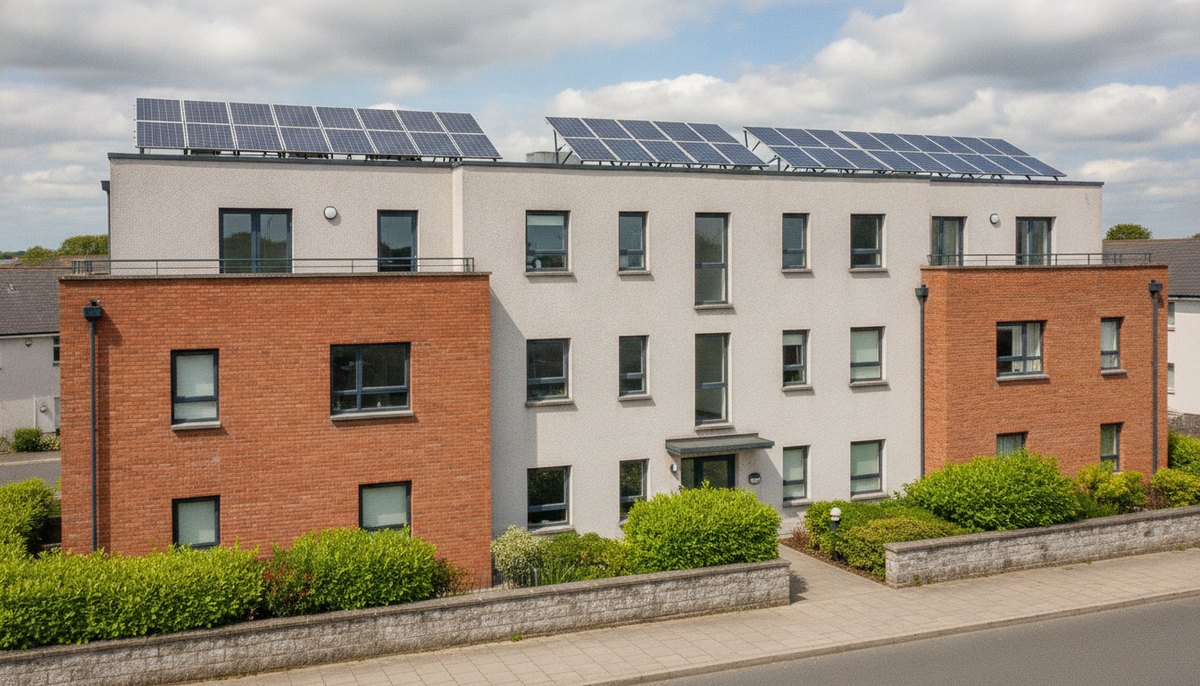
An individual apartment owner cannot usually claim the SEAI solar PV grant on their own, because the roof of an apartment block is a common area owned by the owners' management company (OMC), not by any one owner. The grant itself is not the obstacle: SEAI explicitly lists owner management companies among the applicant types eligible for the Solar PV Scheme, alongside homeowners, private landlords and Approved Housing Bodies. So the realistic route to grant-supported solar on an apartment building runs through the OMC, which applies through a dedicated SEAI process. Since 2022, rooftop solar on apartment buildings is also exempt from planning permission within set limits, which removed one of the old blockers.
- Individual owners: can't normally apply alone. The roof belongs to the OMC as a common area, so no single owner can put panels on it
- The OMC: is an eligible SEAI applicant. Applications are made by the OMC or its property management agent, with written OMC authorisation, using forms requested from SEAI
- Grant value: the scheme pays €700 per kWp up to 2 kWp, then €200 per kWp to 4 kWp, capped at €1,800, unchanged for 2026
- Eligibility: built and occupied before 2025, an MPRN, no previous solar PV funding at that meter
- Planning: rooftop solar on apartment buildings has been exempt from planning permission since October 2022, within set limits
Why an Apartment Owner Can't Just Apply
When you buy an apartment in Ireland you own the unit itself. The structure around it belongs to the owners' management company. Under the Multi-Unit Developments Act 2011, the common areas of a development are transferred to the OMC, and Citizens Information's guidance lists exactly what those common areas include: the external walls, the foundations, and the roofs. The OMC is also the body responsible for maintaining, insuring and repairing them.
That's the whole problem in one sentence. The SEAI solar PV grant funds panels on a roof, and the roof of your block is not yours to put panels on. Even before any grant paperwork, an installation on the roof needs the consent of the body that owns it. A single owner acting alone has no legal basis to install, and no practical way to meet the scheme's requirement that the applicant owns the property being upgraded.
There is one consolation built into the same structure: every unit owner is automatically a member of the OMC, generally with one vote. You can't put panels on the roof yourself, but you have a formal say in whether the block does.
The Route That Works: an OMC Application
SEAI's Solar Electricity Grant page lists three eligible applicant types: all homeowners including private landlords, owner management companies, and Approved Housing Bodies. Apartment blocks are exactly why OMCs are on that list.
The OMC application is handled differently from an ordinary homeowner application. SEAI's published process says OMC applications can only be created by the OMC itself or its associated property management agency, with written authorisation from the OMC, and the forms are requested directly from the Solar PV team at solarpv@seai.ie or 01 808 2004. It doesn't go through the standard online portal in the way a house application does.
The scheme's core rules still apply:
- The building must have been built and occupied before 2025, the same age rule as for houses.
- The property needs an MPRN (meter point), and no previous solar PV funding can have been paid at that MPRN.
- The work must be done by an SEAI-registered company, with grant approval in place before works start, and there's an 8-month window to complete the works and submit the paperwork once approved.
- A post-works BER assessment is required before the grant is paid out.
The grant values are the standard scheme rates:
| System size | SEAI grant |
|---|---|
| Up to 2 kWp | €700 per kWp (so €1,400 at 2 kWp) |
| Each kWp from 2 to 4 kWp | €200 extra per kWp |
| 4 kWp and above | €1,800 (the maximum, confirmed unchanged for 2026) |
An apartment-block roof can often carry far more than 4 kWp, and how a specific block's application is sized and structured is exactly what the OMC should clarify with SEAI when requesting the forms. The practical figures worth having ready for that conversation are on our main SEAI solar grant guide.
In most OMC installations the panels feed the building's communal supply: lifts, corridor and stairwell lighting, car park lighting, pumps. The saving lands on the electricity account the OMC already pays through the service charge, so every owner benefits indirectly through the block's running costs rather than on their own bill. Any export payment follows the same logic as elsewhere: it goes to whoever holds the electricity account for the meter the panels feed. Our Clean Export Guarantee guide explains how those export rates work.
Planning Permission: Sorted Since 2022
Planning used to be a genuine barrier for apartment blocks, because the long-standing exemption for rooftop solar applied to houses and explicitly excluded apartments. That changed in October 2022, when S.I. No. 493/2022 created a new exemption class (Class 60) specifically for buildings comprising apartments.
Rooftop solar on an apartment building is now exempt from planning permission provided the installation stays within the conditions, the main ones being:
| Condition | Limit |
|---|---|
| Height above a flat roof | Panels no more than 1.2 m above the roof plane (15 cm on a pitched roof) |
| Edge setback | At least 2 m from the edge of a flat roof (50 cm on a pitched roof) |
| Ancillary equipment (inverters etc.) | Flat roofs only, no more than 1.6 m above roof level, at least 2 m from the edge |
| Wall-mounted or free-standing systems | Not exempt on apartment buildings; rooftop only |
| Solar safeguarding zones (near airports) | Rooftop area capped at 300 m² and the planning authority must be notified within 4 weeks of starting |
| Use of the electricity | More than half must be used within the building's own curtilage |
Installations that fall outside these conditions, and buildings that are protected structures, still need planning permission the ordinary way. The wider rules for houses and other building types are covered in our solar planning permission guide.
What You Can Do as an Individual Owner
1. Bring it to the OMC. This is the lever that actually moves. You're a member of the company that owns the roof, so raise solar at the AGM or put it to the directors in writing: the block is an eligible SEAI applicant, planning is exempt within the Class 60 limits, and the communal electricity bill is the obvious beneficiary. A costed proposal from an SEAI-registered installer makes the conversation concrete. Blocks with high communal electricity use (lifts, car park lighting, pumps) have the strongest case.
2. Plug-in solar for your own unit. If you have a south-facing balcony, a plug-in solar kit is the one option that doesn't touch the common areas' roof. Kits cost roughly €200 to €600, generate around 300 to 400 kWh a year from a 400W panel, and plug into a normal socket. They don't qualify for the SEAI grant and the output is a fraction of a rooftop system, but for an apartment dweller they're often the only solar you can install on your own decision. Our plug-in solar panels guide covers the costs, the rules and the realistic payback.
3. If you're a landlord who owns an apartment, the same roof problem applies to your unit, but the grants-and-tax picture for rental properties is different and worth knowing before an OMC conversation: see our solar for landlords guide.
We can match your block with SEAI-registered installers who handle apartment and multi-unit work. A free, no-obligation quote gives the OMC real numbers to vote on instead of a vague idea.
Get a Quote →Frequently Asked Questions
Not usually on their own. The roof of an apartment block is a common area owned by the owners' management company (OMC) under the Multi-Unit Developments Act 2011, so an individual owner has nowhere to install panels. The workable route is through the OMC: SEAI lists owner management companies as eligible applicants for the Solar PV Scheme, and the OMC or its managing agent applies with written OMC authorisation using forms requested from SEAI.
The owners' management company. Under the Multi-Unit Developments Act 2011, the common areas of a development are transferred to the OMC, and those common areas include the external walls, foundations and roofs. Every unit owner is automatically a member of the OMC, generally with one vote, which is how individual owners get a say in decisions about the roof.
Through a dedicated process rather than the standard online portal. SEAI states that OMC applications can only be created by the OMC unit or its associated property management agency, with written authorisation from the OMC. The forms are requested from the SEAI Solar PV team at solarpv@seai.ie or 01 808 2004. The standard scheme rules still apply: built and occupied before 2025, an SEAI-registered installer, approval before works start, and a post-works BER.
Usually not any more. Since October 2022, rooftop solar on a building comprising apartments is exempt from planning permission under Class 60 of the planning regulations, provided the installation meets the conditions: no more than 1.2 m above a flat roof (15 cm on a pitched roof), at least 2 m from a flat roof's edge, ancillary equipment on flat roofs only, and more than half the electricity used within the building. Wall-mounted and free-standing systems are not exempt on apartment buildings, and protected structures still need permission.
Plug-in solar kits are the realistic option for a balcony. They cost roughly €200 to €600, generate around 300 to 400 kWh a year from a 400W panel, plug into a normal socket, and don't involve the block's roof. They don't qualify for the SEAI grant. Check your lease and any house rules first, since OMCs can have rules about what's fixed to balconies and external surfaces.
In most OMC installations the panels feed the communal supply: lifts, corridor lighting, pumps and other shared services. The saving lands on the electricity account the OMC pays, which is funded by every owner's service charge, so owners benefit through the block's running costs rather than on their individual bills. Any export payment goes to whoever holds the electricity account for the meter the panels feed.
Sources: SEAI — Solar Electricity Grant (eligible applicant types: all homeowners including private landlords, owner management companies, Approved Housing Bodies; OMC application process and contact route; €700/kWp to 2 kWp, €200/kWp to 4 kWp, €1,800 cap confirmed unchanged for 2026; pre-2025 build rule, MPRN, 8-month completion window, post-works BER); S.I. No. 493/2022 (Class 60 planning exemption for rooftop solar on buildings comprising apartments and its conditions; house exemption in Class 2(c) excludes apartments); Citizens Information — Management companies for apartment blocks (Multi-Unit Developments Act 2011; common areas include external walls, foundations and roofs; common areas transferred to the OMC; automatic OMC membership and voting). All verified 6 July 2026.
Published: 6 July 2026. Author: Neil Russell. This page is general information, not legal advice — an OMC considering works should confirm its own position with SEAI and its legal advisers.