
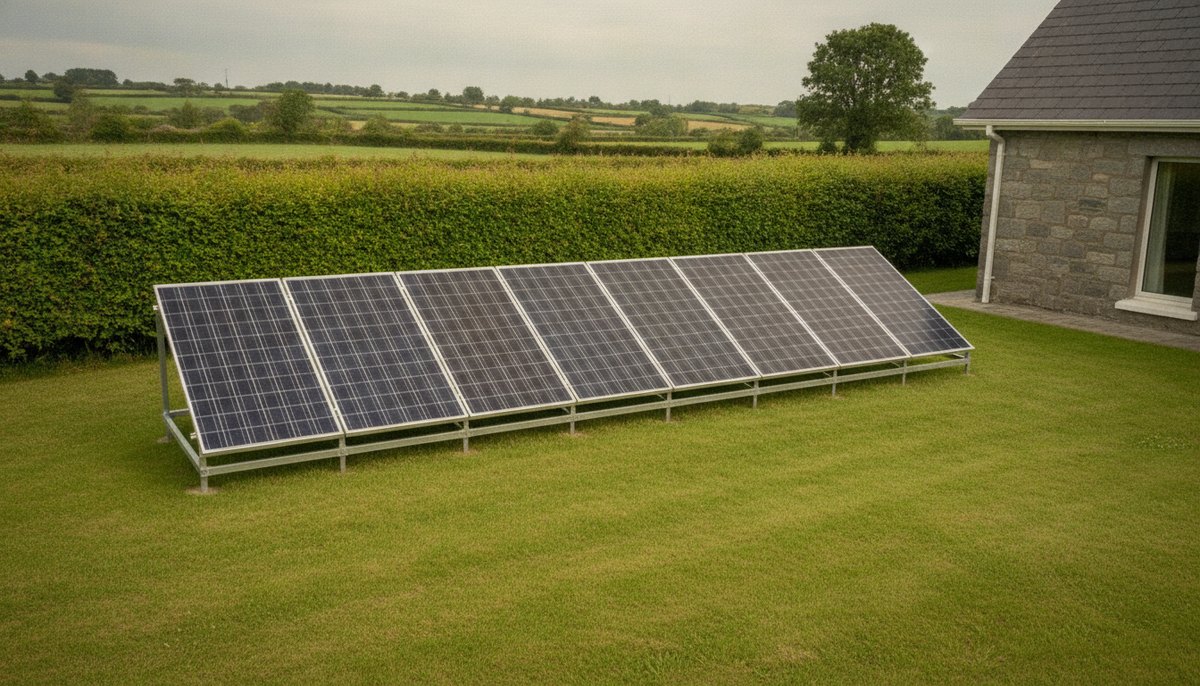
Ground-mounted solar panels are a real option in Ireland, and for most homes they don't need planning permission. A free-standing solar array on a frame in your garden is exempt from planning permission as long as it stays under 2 metres high, sits behind the front wall of the house, and the panels total no more than 25 square metres. The SEAI grant of up to €1,800 applies to ground-mounted systems exactly as it does to roof ones, and the grid connection runs through the same NC6 process. The trade-off is cost: a ground array needs a frame and groundworks the roof doesn't, so it usually comes in dearer than the equivalent rooftop system.
- Planning: exempt up to 25 m² of panels, max 2 m high, behind the front wall of the house — no permission needed if you stay inside those limits
- Grant: the SEAI solar PV grant (up to €1,800) covers ground-mounted systems, same eligibility as roof-mounted
- Grid & export: same NC6 form to ESB Networks and same Clean Export Guarantee payments as a rooftop system
- Cost: typically more than an equivalent roof system because of the frame, groundworks and cable run — the upside is ideal angle and easy access
Do Ground-Mounted Solar Panels Need Planning Permission?
For most homes, no. Since the planning rules were overhauled in October 2022, free-standing solar arrays at houses are exempt from planning permission — but, unlike rooftop solar, the exemption comes with size and siting limits. The relevant law is the Planning and Development Act 2000 (Exempted Development) (No. 3) Regulations 2022, signed by the Minister for Housing.
Your ground array is exempt from planning permission if it meets all of these conditions:
| Condition | The limit |
|---|---|
| Total panel area | No more than 25 m² of free-standing solar panels (PV and solar thermal counted together, including any already in the garden) |
| Height | No more than 2 metres above ground level at the highest point |
| Position | Not on or forward of the front wall of the house — so rear or side garden only |
| Open space left over | The array must not reduce the private open space to the rear or side of the house to less than 25 m² |
Go beyond any one of those — a taller frame, panels in the front garden, or more than 25 m² — and you need planning permission from your local authority. The same goes if your home is a protected structure or sits in an Architectural Conservation Area: the exemption is removed where a free-standing array would materially affect the character of the structure or area, so check with your council's planning department first.
A standard domestic panel is roughly 1.8–2 m². That means the 25 m² cap fits around 12 to 13 panels — broadly a 5 kW system at today's panel wattages. For most households that's a full-size installation, so the exemption rarely forces you to scale down. It only bites if you were planning a large garden array on top of panels you already have.
Does the SEAI Grant Cover Ground-Mounted Panels?
Yes. The SEAI solar PV grant — worth up to €1,800 in 2026 — supports solar electricity systems for homes, and it isn't limited to roof installations. Whether your panels sit on the roof or on a frame in the garden, the grant is assessed on the system and the installer, not on where the panels are mounted.
The standard eligibility rules still apply, and they're the same ones that catch out rooftop applicants:
- Your home must have been built and occupied before 2025 (if you're unsure of the year, ESB Networks can tell you when the home was first connected).
- The work must be done by an SEAI-registered installer — you apply for the grant before the work starts, and the panels and equipment must meet SEAI's technical standards.
- A BER assessment is required after the works are completed.
None of those depend on roof versus ground. If your installer is SEAI-registered and your home qualifies, a garden array draws the same grant as a rooftop one. Our guide to the SEAI solar grant covers the full eligibility checklist and how the €1,800 is paid.
Connecting a Ground Array to the Grid
A ground-mounted system connects to the grid in exactly the same way as a rooftop one — there is no separate process for garden panels. Your installer submits an NC6 notification form to ESB Networks, and the same "inform and fit" thresholds apply: up to 25 amps (about 6 kVA) on a single-phase home, or 16 amps per phase (about 11 kVA) on three-phase. Stay under that and there's no charge to connect and no prior approval to wait on — you can connect once 20 business days have passed without ESB Networks raising an objection.
Export payments work identically too. Once your smart meter is in and the NC6 is processed, your supplier pays you their Clean Export Guarantee rate on every unit you send to the grid. The mount type makes no difference to what you're paid.
What Ground-Mounted Solar Costs — and Why It's More
A garden array almost always costs more than the same number of panels on your roof. The panels and inverter are the same; the extra goes on parts of the job a roof gives you for free:
- The mounting frame. A ground frame is a bigger, heavier structure than roof rails, often set into concrete footings.
- Groundworks. Digging footings and, in some cases, pouring a concrete base adds labour and materials.
- The cable run. Cable has to be trenched from the array back to the house and the consumer unit — the further the panels are from the building, the more this costs.
Because the SEAI grant is a fixed amount rather than a percentage, that extra cost lands entirely on you: the €1,800 is the same whether the system is cheap or dear, so a pricier ground install means a longer payback. That's the main reason ground mount is the exception rather than the rule in Irish gardens — it's chosen when the roof can't do the job, not to save money.
When Ground Mount Is the Right Call
Despite the cost, a ground array is the better answer in a few common situations:
- The roof faces the wrong way. If your roof is north-facing, heavily shaded by chimneys or trees, or broken up by dormers and rooflights, a ground frame lets you point the panels due south at the ideal pitch — often recovering more generation than a compromised roof ever could.
- The roof can't take the weight or the work. Older slate, fragile tiles, or a roof due for replacement can make rooftop mounting awkward or risky. The garden sidesteps that entirely.
- You've plenty of land. On a rural site or a larger garden, a ground array is easy to access for cleaning and maintenance, and there's room to angle it perfectly.
- You're already at the roof's limit. If a south-facing roof is full and you want more generation, a garden array adds capacity the roof can't.
For a typical house with a decent south-, east- or west-facing roof, rooftop solar is still cheaper and simpler. Ground mount earns its keep when the roof is the problem. If your roof is flat rather than pitched, that's usually no obstacle at all — see our guide to solar panels on a flat roof before ruling the roof out.
We match you with SEAI-registered installers in your county who fit both roof and ground arrays. They'll tell you whether the garden or the roof gives you more for your money, handle the grant and the NC6 form, and quote you for free.
Get a Quote →Frequently Asked Questions
Usually not. A free-standing solar array at a house is exempt from planning permission as long as the panels total no more than 25 square metres, the frame is under 2 metres high, it sits behind the front wall of the house, and it doesn't reduce the private open space to the rear or side below 25 square metres. Go beyond any of those limits, or if your home is a protected structure or in an Architectural Conservation Area, and you need permission from your local authority.
Yes. The SEAI solar PV grant of up to €1,800 applies to ground-mounted systems on the same terms as rooftop ones. The grant is based on the system and a registered installer, not on where the panels are mounted. Your home must have been built and occupied before 2025, the work must be done by an SEAI-registered installer, and a BER assessment is required after the works.
A standard domestic panel is roughly 1.8 to 2 square metres, so 25 square metres holds around 12 to 13 panels — broadly a 5 kW system at current panel wattages. For most households that's a full-size installation, so the exemption rarely forces you to install fewer panels than you wanted.
Generally yes. The panels and inverter cost the same, but a ground array needs a mounting frame, groundworks for the footings, and a trenched cable run back to the house — costs a roof installation avoids. Because the SEAI grant is a fixed amount rather than a percentage, that extra cost falls entirely on you, so ground mount usually has a longer payback than the equivalent rooftop system.
No. The grid connection is identical to a rooftop system. Your installer submits an NC6 form to ESB Networks under the same "inform and fit" limits — up to about 6 kVA single phase or 11 kVA three phase — and there's no charge to connect within those limits. Export payments through the Clean Export Guarantee work the same way once your smart meter is installed and the NC6 is processed.
Ground mount makes sense when the roof faces the wrong way, is shaded or cluttered, can't take the weight, or is already full of panels — or when you have the land and want the panels at the ideal angle with easy access for maintenance. For a typical house with a usable south-, east- or west-facing roof, rooftop solar is still cheaper and simpler.
Sources: gov.ie — New planning permission exemptions for solar panels and the Planning and Development Act 2000 (Exempted Development) (No. 3) Regulations 2022, S.I. No. 493 of 2022 (free-standing 25 m² area limit, 2 m height, front-wall and open-space conditions, protected-structure de-exemption); SEAI — Solar Electricity Grant (grant value, installer and eligibility rules); ESB Networks — Micro-generation (NC6 process, inform-and-fit thresholds, free connection up to 6 kVA single phase, 20-business-day rule). All verified 24 June 2026.
Published: 24 June 2026. Author: Neil Russell.