
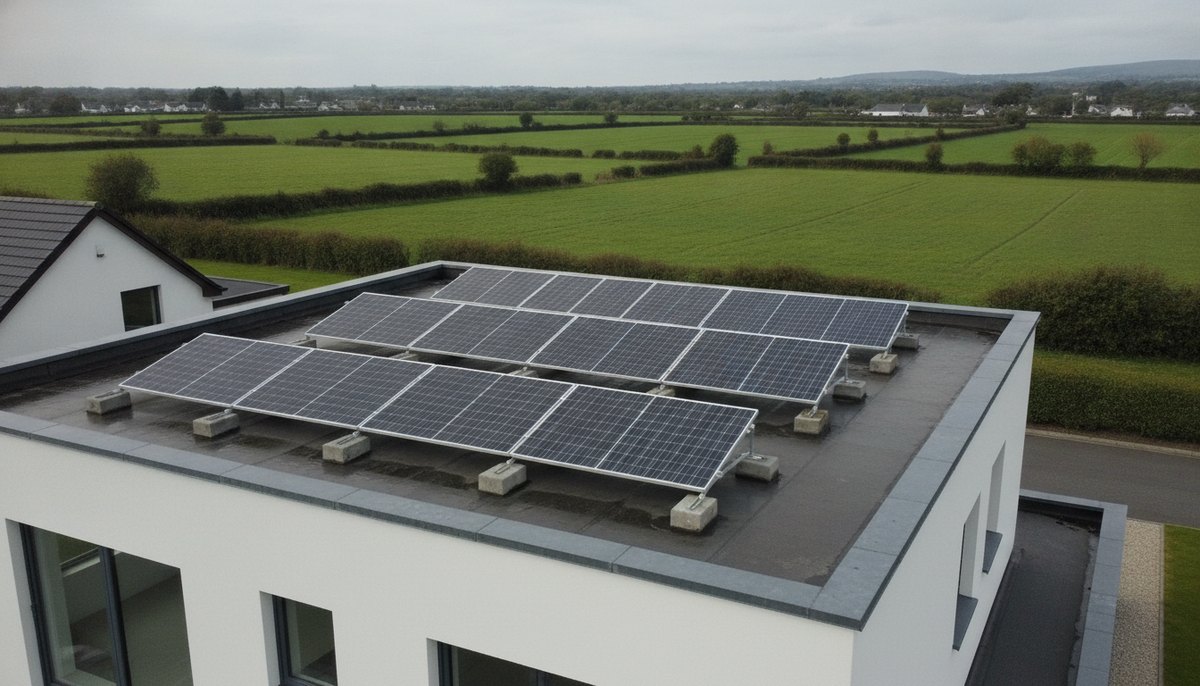
Yes, you can put solar panels on a flat roof in Ireland — and in most cases without planning permission. The SEAI grant of up to €1,800 applies exactly as it does on a pitched roof, because the grant follows the system and the installer, not the roof. The difference is in two places: the planning rules let panels project further above a flat roof than a pitched one but cap that projection at 50 centimetres, and the panels are usually fixed with a weighted, non-penetrating frame rather than bolted through the roof. Get those two right and a flat roof is one of the most flexible surfaces to mount on, because you choose the angle and direction the panels face.
- Planning: rooftop solar on a house is exempt with no area cap — but on a flat roof the panels and frame must stay within 50 cm of the roof plane and at least 50 cm from the edge
- Grant: the SEAI solar PV grant (up to €1,800) covers flat-roof systems on the same terms as any other roof
- Mounting: usually a ballasted (weighted) tilt frame that doesn't penetrate the roof membrane — the panels are angled rather than laid flat
- Grid & export: same NC6 form to ESB Networks and same Clean Export Guarantee payments as any rooftop system
Do Flat-Roof Solar Panels Need Planning Permission?
For a house, almost never — but the flat-roof condition is the one people miss. Since the planning rules were overhauled in October 2022, rooftop solar on a house has no area limit at all: you can cover the whole roof. That generous exemption comes from the Planning and Development Act 2000 (Exempted Development) (No. 3) Regulations 2022, signed by the Minister for Housing. But the regulations set a limit on how far the panels can stand off the roof, and a flat roof is treated differently from a pitched one.
| Condition | The limit on a flat roof |
|---|---|
| Projection above the roof | The gap between the roof plane and the panels must not exceed 50 cm (on a pitched roof the limit is just 15 cm) |
| Distance from the edge | Panels must sit at least 50 cm in from the edge of the roof |
| Area | No cap for a house — the panels can cover the available roof |
| Building type | The house-roof exemption does not apply to apartments |
The 50 cm projection limit is the one that bites on a flat roof, because flat-roof panels are tilted up on a frame rather than lying along the slope. A steep tilt frame raises the top edge of the panel well off the roof, and if that pushes the panels more than 50 cm above the roof plane, the installation is no longer exempt and you would need planning permission. A good installer designs the tilt angle to stay inside the 50 cm envelope — which on a domestic flat roof usually means a shallow tilt of around 10 to 15 degrees.
Pitched-roof panels follow the slope, so the law only allows a 15 cm gap. A flat roof has no slope to follow, so the regulations give it a larger 50 cm allowance to fit a tilt frame underneath. The trap is assuming "flat roof, no slope, no problem" and fitting a tall A-frame: go over 50 cm and the exemption is lost. Keep the design low and you stay exempt.
Two other situations remove the exemption regardless of the roof: if your home is a protected structure or sits in an Architectural Conservation Area, the automatic exemption can fall away where the panels would affect the character of the building or area, so check with your council's planning department first. Our full guide to solar planning permission in Ireland walks through every roof type and the apartment and conservation cases.
Does the SEAI Grant Cover a Flat Roof?
Yes — in full. The SEAI solar PV grant, worth up to €1,800 in 2026, supports home solar electricity systems and makes no distinction between a flat roof, a pitched roof or a ground-mounted frame. The grant is assessed on the system and the registered installer, not on the shape of your roof.
The grant is paid on a per-kilowatt basis up to the cap:
| System size | SEAI grant |
|---|---|
| Up to 2 kWp | €700 per kWp (so €1,400 at 2 kWp) |
| Each kWp from 2 to 4 kWp | €200 extra per kWp |
| 4 kWp and above | €1,800 (the maximum) |
The standard eligibility rules apply on a flat roof exactly as they do anywhere else:
- Your home must have been built and occupied before 2025, and have its own MPRN (meter point).
- The work must be done by an SEAI-registered installer, and you must have grant approval in place before the work starts. You then have 8 months to complete the job and submit the paperwork.
- No previous solar PV grant can have been paid at the same MPRN.
Private landlords are eligible too, alongside homeowners, owner-management companies and approved housing bodies. Our guide to the SEAI solar grant sets out the full checklist and how the €1,800 is paid.
How Solar Panels Are Fixed to a Flat Roof
This is the real difference between a flat roof and a pitched one. A pitched roof has rails hooked over or screwed into the rafters. A flat roof has no slope and a waterproof membrane you don't want to put holes in, so installers use one of two approaches:
- Ballasted (non-penetrating) frames are the usual choice. The tilt frame sits on protective mats on the roof and is held down by concrete or rubber ballast blocks — its own weight resists wind uplift, and nothing penetrates the membrane. This keeps the roof watertight and is fully reversible.
- Penetrating (fixed) mounts bolt the frame through the membrane into the roof structure, with the fixings sealed and flashed. These are used where the roof can't take the extra ballast weight, or where wind exposure is high enough that ballast alone won't hold the array down.
Two practical points decide which you get. First, weight: a ballasted array adds load spread across the roof, so the installer needs to be confident the flat roof structure can carry it — older or lightweight flat roofs may not. Second, wind: an exposed or coastal site increases uplift, which pushes the design towards heavier ballast or penetrating fixings. A proper survey covers both before any frame goes down.
Panels are angled on a flat roof for two reasons: a tilt catches more of the low Irish sun than a horizontal panel, and it lets rain run off and wash the surface clean. Lay panels dead flat and they generate less and collect dirt and standing water. The tilt is kept shallow — around 10 to 15 degrees on a domestic roof — both to manage wind load and to stay under the 50 cm planning projection limit.
What It Costs and How a Flat Roof Compares
A flat-roof system uses the same panels and inverter as any other install. The mounting is different — tilt frames and ballast instead of roof rails — but the cost is broadly in the same range as a pitched-roof system of the same size, and well below a ground-mounted array, which needs groundworks and a trenched cable run. Because the SEAI grant is a fixed amount rather than a percentage, the €1,800 lands the same way on a flat roof as anywhere else.
The flat roof's real advantage is freedom of orientation. On a pitched roof you're stuck with whichever way the slope faces; on a flat roof the installer can point every panel due south at the ideal pitch, which can recover generation a poorly-oriented pitched roof would lose. For a sense of what a typical system costs before the grant, see our breakdown of 3 kW solar system costs in Ireland.
Connecting and Getting Paid for Export
The grid connection is identical to any rooftop system — the mount type makes no difference. Your installer submits an NC6 notification form to ESB Networks, and the same "inform and fit" thresholds apply: up to 25 amps (about 6 kVA) on a single-phase home, or 16 amps per phase (about 11 kVA) on three-phase. Within those limits there's no charge to connect and no prior approval — you can connect once 20 business days have passed without ESB Networks objecting.
Export payments work the same way too. Once your smart meter is fitted and the NC6 is processed, your supplier pays you their Clean Export Guarantee rate for every unit you send back to the grid, whether the panels sit on a flat roof, a pitched one or a frame in the garden.
We match you with SEAI-registered installers in your county who fit flat-roof systems. They'll survey the roof structure, design the tilt and ballast to stay inside the planning limits, handle the grant and the NC6 form, and quote you for free.
Get a Quote →Frequently Asked Questions
Yes. Flat roofs take solar panels well and are exempt from planning permission on a house, with no area limit. The panels are usually fitted on a weighted tilt frame that angles them towards the sun without penetrating the roof. The one planning condition specific to flat roofs is that the panels and frame must not project more than 50 centimetres above the roof plane, and must sit at least 50 centimetres in from the edge.
Usually not. Rooftop solar on a house has been exempt from planning permission with no area cap since October 2022. On a flat roof the exemption applies as long as the panels and frame stay within 50 centimetres of the roof plane and at least 50 centimetres from the edge. You lose the exemption if a tall tilt frame pushes the panels over 50 centimetres, if the building is an apartment, or if your home is a protected structure or in an Architectural Conservation Area.
Yes. The SEAI solar PV grant of up to €1,800 applies to flat-roof systems on the same terms as any other roof. The grant is based on the system size and a registered installer, not on the type of roof. Your home must have been built and occupied before 2025, the work must be done by an SEAI-registered installer with grant approval in place before it starts, and no previous solar PV grant can have been paid at the same meter.
Most flat-roof systems use a ballasted tilt frame: the frame sits on protective mats and is weighted down with concrete or rubber ballast blocks, so nothing penetrates the waterproof membrane and the roof stays watertight. Where the roof can't carry the ballast weight or the site is very exposed to wind, installers instead bolt the frame through the roof into the structure, with the fixings sealed and flashed. A survey of the roof structure and wind exposure decides which is used.
Panels on a flat roof are tilted on a frame rather than laid flat, typically at a shallow angle of around 10 to 15 degrees for a domestic system. The tilt helps catch the low Irish sun and lets rain wash the panels clean. The angle is kept shallow partly to manage wind load and partly to keep the panels within the 50 centimetre projection limit that the planning exemption allows on a flat roof.
Not significantly. A flat-roof system uses the same panels and inverter and costs broadly the same as a pitched-roof system of the same size — the mounting is different, with tilt frames and ballast instead of roof rails, but it isn't far apart on price. A flat roof is cheaper than a ground-mounted array, which needs groundworks and trenching, and it has the advantage of letting you point every panel due south at the ideal angle.
Sources: Planning and Development Act 2000 (Exempted Development) (No. 3) Regulations 2022, S.I. No. 493 of 2022 (50 cm flat-roof projection limit vs 15 cm pitched, 50 cm edge setback, no area cap for houses, apartment exclusion); gov.ie — New planning permission exemptions for solar panels; SEAI — Solar Electricity Grant (grant values, €700/kWp to 2 kWp then €200/kWp to the €1,800 cap, pre-2025 and registered-installer eligibility, landlords eligible, 8-month completion window); ESB Networks — Micro-generation (NC6 process, inform-and-fit thresholds, free connection up to 6 kVA single phase, 20-business-day rule). All verified 28 June 2026.
Published: 28 June 2026. Author: Neil Russell.