
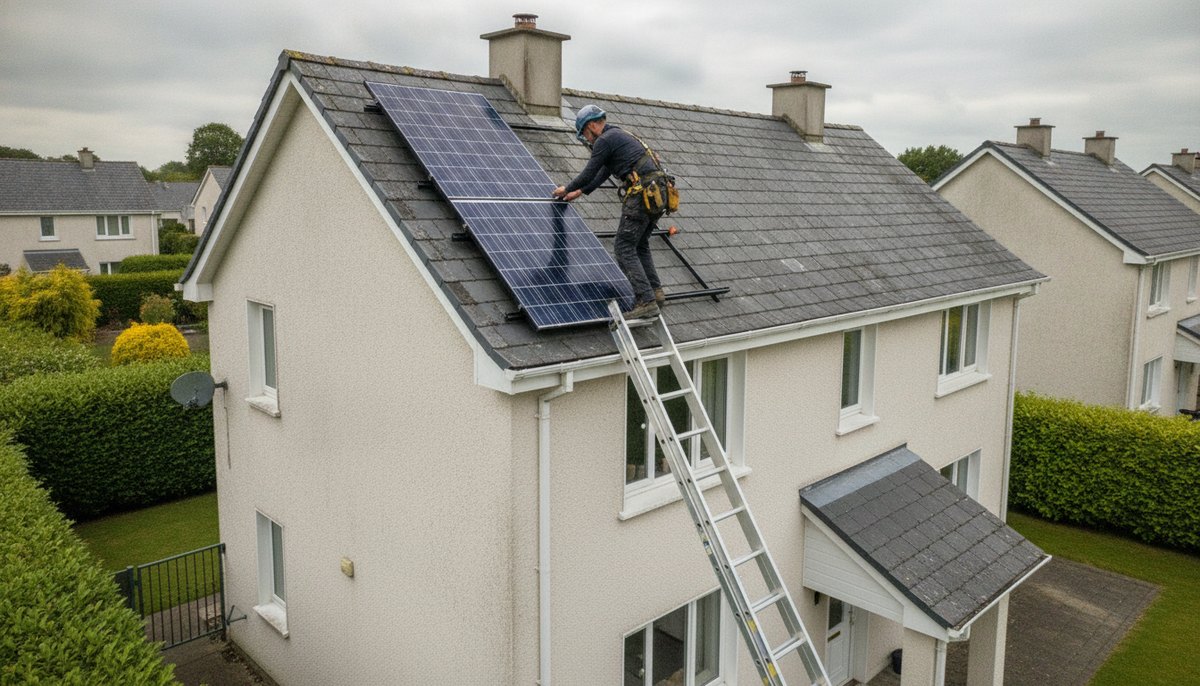
The Micro-generation Support Scheme (MSS) is the Irish government framework that sits behind home solar. It is not a single payment. It is the umbrella for two separate supports: the SEAI solar PV grant of up to €1,800 towards installation, and the Clean Export Guarantee (CEG), the payment your electricity supplier makes for every surplus unit you export to the grid. People regularly mix the three names up, and the confusion costs money, because each support has its own rules, its own application route and its own paperwork.
- MSS = the overall government scheme. You never "apply for the MSS" directly.
- Pillar 1, the SEAI grant: up to €1,800 off a home solar install. Applied for through SEAI before work starts. Home must be built and occupied before 2025.
- Pillar 2, the Clean Export Guarantee: a per-kWh payment for exported electricity, currently 15.89c to 25c/kWh on standard tariffs. Paid by your supplier, no pre-2025 rule.
- Tax: the first €400 a year of export income is exempt until 31 December 2028 (Budget 2027 announced a rise to €600).
- Farms, businesses and community buildings are covered too, through separate non-domestic supports.
What Is the Microgeneration Support Scheme?
The MSS is the policy framework the Government put in place so that homes, farms, businesses and community buildings can generate their own renewable electricity and sell the excess back to the grid. It is overseen by the Department of Climate, Energy and the Environment, with two other bodies running the working parts: SEAI administers the grants, and the CRU (Commission for Regulation of Utilities) regulates the export payment arrangements.
That split is why the scheme confuses people. When you get solar panels in Ireland you deal with SEAI for the grant, ESB Networks for the grid connection, and your electricity supplier for the export payment. All three of those interactions happen "under" the MSS without the scheme's name ever appearing on a form.
MSS vs SEAI Grant vs CEG: Which Is Which?
| Term | What it is | Who you deal with |
|---|---|---|
| Microgeneration Support Scheme (MSS) | The umbrella government scheme. Sets the policy; has no application form of its own. | Nobody directly |
| SEAI Solar PV Grant | Up-front support of up to €1,800 towards a home solar install. Funded under the MSS. | SEAI, before work starts |
| Clean Export Guarantee (CEG) | Ongoing per-kWh payment for surplus electricity you export. Every licensed supplier must offer a rate. | Your electricity supplier — compare Clean Export Guarantee rates |
If you have heard the phrase "feed-in tariff", that is the same thing as the CEG in everyday Irish usage. There is no separate fixed government tariff. We cover that naming tangle in our feed-in tariff guide.
Pillar 1: The SEAI Solar PV Grant
The grant pays €700 per kWp for the first 2 kWp and €200 for each additional kWp up to 4 kWp, capped at €1,800, a level SEAI has confirmed stays in place for 2026. It is open to homeowners (including private landlords), owner management companies and approved housing bodies, and it is paid on a pro-rata basis, so a 2.5 kWp system gets €1,500.
The catch most people miss: you must have grant approval before installation starts, and once approved you have 8 months to complete the work. The full walkthrough is in our grant application guide.
Pillar 2: The Clean Export Guarantee
Once your system is connected and registered, your supplier pays you for every unit you export. The CRU decided suppliers set their own CEG rates competitively, so the rate depends entirely on who you are with. Standard tariffs currently run from 15.89c/kWh at the bottom to 25c/kWh at the top. On a typical 4 kWp home exporting around 1,400 kWh a year, that gap is worth over €100 annually, which makes our Clean Export Guarantee rate comparison the single most useful five minutes a solar owner can spend.
Getting paid requires the plumbing to be in place: your installer lodges an NC6 form with ESB Networks (for systems under 6 kW single-phase or 11 kW three-phase; larger systems up to 50 kW use the NC7), and payment on your actual export needs a smart meter. Homes that don't yet qualify for a smart meter are paid on a "deemed" estimate calculated using a CRU formula.
Who Qualifies, and for Which Part
This is where the two pillars genuinely differ, and where most of the confusion lives:
- The grant has the pre-2025 rule. To get the SEAI grant your home must have been built and occupied before 2025, have an MPRN, and have had no previous SEAI solar funding at that address. There is no minimum BER requirement.
- The CEG does not. Any home with a registered microgeneration connection and an electricity supplier can be paid for exports — including new builds that don't qualify for the grant. A 2023-built house gets no grant, but earns the same export rate as everyone else.
So "do I qualify for the Microgeneration Support Scheme?" is really two questions. Plenty of homes qualify for one pillar and not the other.
Farms, Businesses and Community Buildings
The MSS was never homes-only. Non-domestic sites (farms, businesses, schools, community centres) can claim a separate SEAI non-domestic microgeneration grant worth up to €325,200 for larger installs (an enhanced rate for applications made between 6 October 2026 and 6 July 2027), and farmers have a dedicated route through the TAMS 3 solar grant, which covers 60% of costs. The CEG applies to these sites too, with the NC7 form covering systems up to 50 kW.
Every installer in the Solar Quotes Ireland network is SEAI-registered, so your system qualifies for the grant and the Clean Export Guarantee. One short form, a free quote for your county, no fee to you.
Get a quote →Frequently Asked Questions
The Micro-generation Support Scheme (MSS) is the government framework that supports homes, farms, businesses and community buildings generating their own renewable electricity. For homes it has two parts: the SEAI solar PV grant of up to €1,800 towards installation, and the Clean Export Guarantee, a payment from your electricity supplier for surplus electricity you export to the grid. You never apply for the MSS itself: you apply to SEAI for the grant and register with your supplier for the export payment.
No. The SEAI solar grant is one part of the MSS: the up-front support of up to €1,800 towards installing panels. The other part is the Clean Export Guarantee, the ongoing per-kWh payment for exported electricity. SEAI's own grant page states the solar PV scheme is funded under the government's Microgeneration Support Scheme, but the grant and the export payment have separate rules and separate application routes.
Partly. The pre-2025 rule applies to the SEAI grant: your home must have been built and occupied before 2025 to get grant money. But the Clean Export Guarantee has no build-date rule, so any home with a registered microgeneration connection can be paid for exported electricity, so a new build with solar panels earns export income at the same supplier rates as an older home. It just can't claim the €1,800 grant.
There is no single scheme rate. Each electricity supplier sets its own Clean Export Guarantee rate, and as of July 2026 standard tariffs range from 15.89c/kWh to 25c/kWh. A typical 4 kWp home exporting around 1,400 kWh a year earns roughly €222 to €350 depending on the supplier. The first €400 of export income each year is tax-free until the end of 2028. Budget 2027 announced a rise to €600, with the start date to be set in Finance Bill 2026.
The Department of Climate, Energy and the Environment oversees the scheme. SEAI administers the grants, the CRU regulates the export payment arrangements, and ESB Networks handles the physical grid connection through the NC6 and NC7 forms. Your electricity supplier makes the actual Clean Export Guarantee payments.
Published: 4 July 2026. Author: Neil Russell. Scheme structure verified against Citizens Information's micro-generation guide (edited 8 October 2025) and SEAI's live Solar Electricity Grant page in July 2026, which confirms the grant is funded under the Microgeneration Support Scheme and stays capped at €1,800 in 2026. CEG supplier rates per our live rate tracker, checked June 2026. The €400 tax exemption to 31 December 2028 is confirmed via Revenue and Citizens Information. Rates and grant levels can change; check the linked primary sources before committing.